


PIERCING AFTERCARE
General cleaning procedure
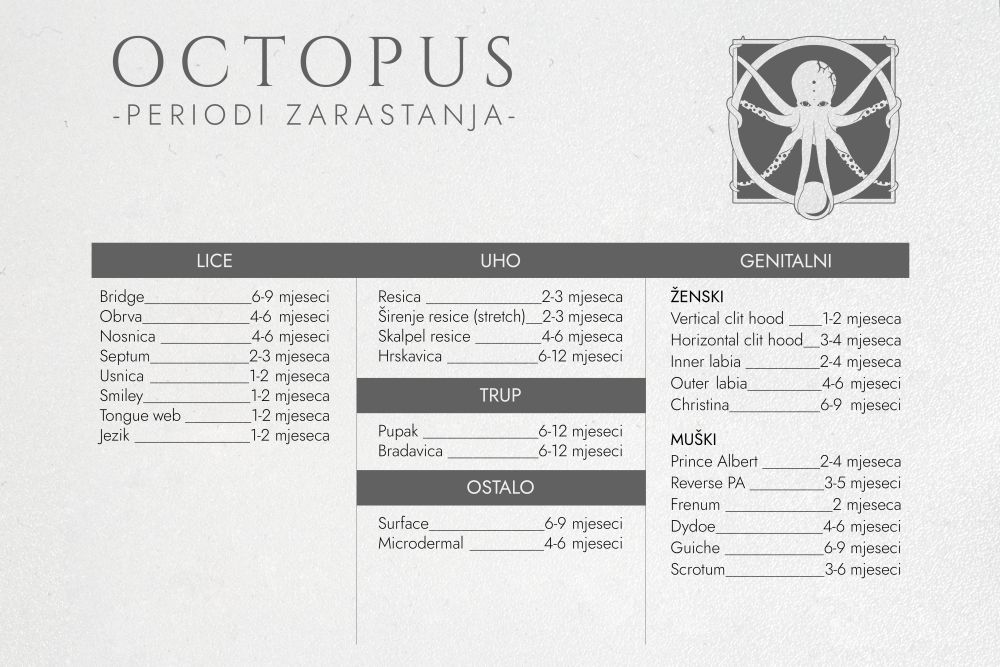
Instructions for piercing care are not universally defined, so different piercing studios may have different guidelines. If you’ve been pierced at Octopus, please follow our piercing care instructions. These instructions have been compiled based on years of experience to help facilitate the healing process.
Piercing jewelry represents a foreign object around which tissue needs to heal. The healing period for an individual piercing can vary, and it may be more or less problematic than average, depending on your immune system, overall care of the piercing, and a range of accidental incidents that could result in piercing problems.
No two people are identical, and therefore, no two piercings are the same because a piercing adapts to the individual’s body and habits. Two piercings on one person can heal quite differently, even if they are the same type of piercing (e.g., two cartilage piercings).
If you notice that something is wrong with your piercing, please visit the studio for an examination as soon as possible. If you’re unable to visit, please contact us through phone, email, or social media so that we can provide you with the necessary information for further piercing care.
The choice of piercing cleaning products depends on the type of piercing, its location on the body, the amount of bleeding immediately after piercing, your skin type, etc. After getting pierced at Octopus, you will receive detailed piercing care instructions tailored to you and your new piercing. If you decide not to follow these instructions independently, Octopus piercing studio is not responsible for any potential damage to your health, your new piercing, or the piercing jewelry itself. You can purchase all the mentioned products at a pharmacy. Do not use multiple products simultaneously!
Piercings should be cleaned to reduce the risk of inflammation or infection caused by bacteria, but do not overdo the cleaning, i.e., clean the piercing more than necessary. Excessive cleaning can make the healing period more difficult and prolonged because frequent and/or long-term use of some of the mentioned products can lead to skin irritation and dryness.
Always wash your hands carefully and thoroughly before starting to clean or touch the piercing. Hands are constantly exposed to various bacteria and impurities that can easily be transferred to the piercing, leading to inflammation and/or infection. Even when the piercing has healed, do not touch it with unwashed hands!
1. SEPTASOL OXYGEN liquid
Septasol is a natural antiseptic for the skin and mucous membranes; it contains monatomic oxygen that destroys microorganisms on the skin and mucous membranes without harming the cells. Within 5 minutes, it will eliminate microorganisms while simultaneously aiding in the rapid recovery of damaged cells and wound healing. Therefore, it disinfects and heals injuries of all kinds.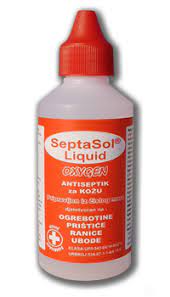
Composition: 99.8% Maris Aqua, 0.2% sodium oxychloride, oxygen.
After the first opening, the product is valid for 6 months. You can purchase a small 10ml pack of Septasol at the Octopus piercing reception, and larger packs can be found in some pharmacies.
During the first 10 days after piercing, in the morning and evening, apply 1-2 drops of Septasol directly from the bottle onto the piercing.
If the piercing becomes swollen or the pierced area throbs and feels hot to the touch, you can place a clean cold compress over the piercing (e.g., cotton wool soaked in cold water). If using ice for the compress, do not apply it directly to the skin; instead, wrap it in gauze or cotton.
Always make sure to thoroughly dry the piercing after showering, as skin moisture (especially in the summer months) can promote bacterial growth.
For the remainder of the healing period, clean the piercing only as needed (if you notice scabs and/or increased lymph discharge). It’s important to reduce the frequency of cleaning the piercing after the initial 10 days to facilitate the skin’s acceptance of the foreign object, i.e., the piercing jewelry. Cleaning the piercing too often and/or for an extended period may lead to dry, scaly, and red skin with increased lymph discharge from the canals.
If you notice heavy discharge, bleeding, significant swelling, bumps, or anything unusual, be sure to contact Octopus for an examination as soon as possible!
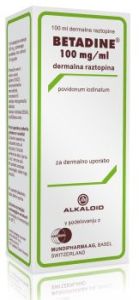 2. BETADINE 10% solution for external use
Betadine is an iodine solution used for disinfecting the skin and minor wounds. After application, allow it to dry for 2-3 minutes. Do not dilute or rinse.
We recommend it for piercings that bleed after being pierced.
For the first 5 days, apply 2-3 drops directly to the piercing. Use it in the morning and evening.
For microdermals, use a small adhesive bandage for the first 2-3 days (remove it for cleaning) – the bandage serves as a jewelry stabilizer, preventing oozing or snagging on the jewelry.
For the remainder of the healing period, clean the piercing only as needed (if you notice scabs and/or increased lymph discharge). It’s important to reduce the frequency of cleaning the piercing after the initial 10 days to facilitate the skin’s acceptance of the foreign object, i.e., the piercing jewelry. Cleaning the piercing too often and/or for an extended period may lead to dry, scaly, and red skin with increased lymph discharge from the canals. If you dislike the brown color of Betadine, after the first 5 days, you can use Septasol instead.
3. COLD SAGE TEA
Sage has natural antiseptic properties and is often used to treat oral and throat conditions. We recommend it for tongue and lip piercings because it soothes the initial swelling, which is normal for these piercings, and acts as a mild disinfectant.
Piercings located within the oral cavity usually heal without major issues because they are surrounded by mucous membranes and are not exposed to external influences (dirt, cosmetics, etc.). It’s essential not to get into the habit of playing with the jewelry as it can lead to swelling over time, the growth of scar tissue, the widening of the canals, and other problems.
During the first week, rinse your mouth with cold sage tea 4-5 times a day.
You don’t have to drink the tea; it’s enough to hold it in your mouth for a few minutes. Do not add sugar to the tea!
For the first ten days, avoid alcohol, hot food and drinks, highly spicy food, and menthol (gums and mouthwash) as they can lead to increased swelling.
If bleeding occurs on the piercing, apply a little ice or rinse your mouth with cold water to constrict the blood vessels and stop the bleeding.
After a tongue piercing, do not clean the tongue with a toothbrush as it may cause irritation.
For piercings inside the oral cavity, you don’t need to use Septasol or any other products (except for lip piercings, where Septasol is used on the external part of the lip). After one week, you can completely stop using sage tea.

Cleaning according to the General Cleaning Procedure, Septasol (1.)
An earlobe piercing typically heals relatively quickly and without major issues if properly maintained (assuming it was done at a professional piercing studio and not with a “piercing gun”). Despite being “just an ear piercing,” the same rules of care and maintenance apply to this piercing as with any other.
Try not to sleep on a new piercing, even if it doesn’t hurt to touch, at least until the healing period is over (for an earlobe, this is a minimum of 2 months). Sleeping on a new piercing can lead to swelling or bleeding. Avoid playing with the jewelry, twisting it, removing, or changing it.
If you’ve ever had your ears pierced at a jeweler’s, forget everything they told you about maintenance because they usually recommend cleaning the piercing with alcohol, turning the jewelry, and changing the earring (known as a “stud” made of non-implant-grade material, which is a nightmare for professional piercers) after two weeks.
Alcohol is a disinfectant that can be used to disinfect undamaged skin, but applying alcohol to a wound (because a new piercing is a wound) will lead to tissue irritation around the piercing. The skin will become dry, sensitive, and painful to touch, and applying alcohol will likely cause a burning sensation.
Turning the jewelry complicates the healing of the piercing because the channel will not be able to epithelialize easily. You also risk infections or the growth of scar tissue.
Changing the jewelry before the healing period is complete can damage the channel that hasn’t fully healed from the inside, leading to swelling and bleeding, and the entire healing process starts over.
Earlobe piercings done with a “piercing gun” (a device used in jewelry stores) are still not banned, although professional piercing associations in countries like the United States advocate for the illegalization of “piercing guns”. You can read more about the difference between needle piercing and “piercing guns” on this link.
Prolonged wearing of large and heavy jewelry can result in stretching the piercing hole. If the lobe piercing was done low, frequent snagging on jewelry or wearing heavy pieces can lead to the lobe splitting.
Cleaning according to the General cleaning procedure, Septasol (1.)
For hard-to-reach areas on the ear (e.g., rook), use cosmetic cotton swabs with a pointed tip (they look like regular cotton swabs, but one end is pointed, and the other is flat; you can buy them at stores like DM or Bipa). Be cautious not to let cosmetics you apply to your face and/or hair (such as creams, powder, exfoliants, shaving foam, hair spray, etc.) come into contact with the piercing during the healing period.
The ear cartilage is connective tissue with no major blood vessels, resulting in reduced blood circulation in that part of the body. This is why piercings on cartilage take a long time to heal, and problems with scar tissue growth around them are common. It is recommended not to sleep on the piercing (the longer, the better) to prevent a complete disruption of blood flow through the cartilage, which hinders piercing healing and can lead to various other problems.
Even when a piercing is not painful to the touch, try to sleep on it as little as possible because, in addition to the aforementioned issues, jewelry migration can occur (shifting of the jewelry from its initial position, i.e., healing at an angle). Once the jewelry migrates, it cannot be corrected. Sleeping on a travel pillow can make life easier during the first few months.
Daith: In recent years, this piercing has gained popularity not only for aesthetic reasons but also for potentially reducing migraine pain. However, specific studies on the connection between this ear piercing and migraines have not been conducted, so we cannot definitively claim that migraines will disappear after getting the piercing. For now, we have only received feedback from several clients who claim that their migraines have significantly reduced or disappeared, but this could be due to a placebo effect.
Industrial: An industrial piercing involves one straight piece of jewelry passing through two holes. Healing can be challenging and may take up to two years. In the first few weeks after piercing, bleeding from the piercing is possible because the jewelry creates tension on the skin from both sides. If this happens, do not remove the jewelry; instead, come to the studio for an examination as soon as possible.
Tragus, Antitragus, Conch: If you wear small earbuds that go inside your ear, avoid them for the first two weeks after getting pierced because they may likely press on the jewelry, causing pain and hindering healing. After two weeks, make sure to disinfect them before wearing (wipe them with Septasol, alcohol, or another disinfectant) and be careful not to snag the jewelry with them.
Triple Forward Helix (TFH): This involves three separate piercings in a very small area of cartilage, so it’s not recommended to get all of them at once to reduce the risk of healing problems. The first and third can be done simultaneously, and the middle one can be done after about three weeks. The cartilage in this area is very thin, and jewelry migration often occurs, with the most common cause being sleeping on the piercing. If you’ve chosen jewelry with gemstones, migration will result in the gemstones not being positioned at the same angle, which may not look aesthetically pleasing. The anatomy of the ear varies for each person, so the final look of the TFH also depends on that – the spacing between the jewelry may be larger or smaller, and the positioning line may be more or less curved.
Cleaning according to the General cleaning procedure:
- gradual stretching with a taper: Septasol (1.)
- scalpel: Betadine (2.)
Stretching any piercing, regardless of how old it is, creates a new wound because it involves tearing the tissue inside the piercing channel. Therefore, the same rules that apply to any fresh piercing also apply to stretching. It must be performed in hygienic conditions, with sterilized instruments, and requires care during both the healing period and afterward. Stretched earlobes can also become infected, scar tissue can form, or a blowout can occur. Improper stretching and poor maintenance can result with the lobe splitting.
The initial jewelry used for stretching should be made of materials that can be autoclave sterilized, such as steel or titanium. Organic materials (wood, horn, bone) should never be used as initial jewelry because they are porous, may not have a perfectly polished surface, and cannot be sterilized. These factors collectively make organic materials ideal breeding grounds for bacteria and can lead to infection. More information about jewelry materials can be found at the link.
The jewelry typically used for stretching earlobes is a flesh tube (a tunnel with two rubber bands). This type of jewelry is suitable because it is longer than most other tunnels, making cleaning easier, and the rubber bands can be adjusted to allow room for potential swelling. Be careful not to snag the jewelry when putting on clothes or drying hair with a towel, as the rubber bands may fall off. If the entire piece of jewelry falls out and isn’t replaced promptly, the stretched lobe will start to shrink.
Two of the most common methods for stretching earlobes are gradual taper stretching and scalpel + taper. A taper is a steel tube that is narrow at one end and wide at the other. The wider end corresponds to the thickness of the jewelry being inserted.
With gradual taper stretching, the piercing channel can be stretched by 2-3 millimeters every five weeks (which is roughly the time it takes for the previous stretch to heal). If you don’t have pierced earlobes, initial piercings can be done with needles ranging from 1.2 to 5 millimeters. Taper stretching can add an additional 2-3 millimeters to that size. At the beginning of stretching, up to around 6 millimeters, the process can be a bit more painful because the channel is narrow, and the tissue provides more resistance. As you continue to wear larger jewelry, the lobe gradually stretches on its own (due to the weight of the jewelry and/or sleeping with the jewelry), making the process easier and less painful over time. The key to gradual stretching is patience. If you don’t wait for the previous stretch to heal completely or stretch more than 4mm at once, various healing problems are possible, requiring downsizing or jewelry removal. If you want to stretch your earlobes quickly, consider the scalpel method. It’s less painful than expected and is truly a “shortCUT.”
Scalpels can be used to stretch the lobe from 0 (or a very small size) to 8 or 10 millimeters, depending on ear anatomy. For sizes smaller than that, gradual stretching is recommended. The scalpel method involves making a small incision, smaller than the size of the jewelry being inserted, and then further stretching it to the desired size using a taper. When stretching with a scalpel, it’s normal for the lobe to swell and bleed at first, and bruising may also occur. It’s advisable to wrap the lobes in sterile gauze for the first few days to minimize jewelry movement while sleeping and prevent jewelry from falling out. Blood from the channel may adhere to the gauze and create scabs – avoid tearing them off as it can lead to heavier bleeding. Always remove the gauze slowly and gently after moistening it with clean lukewarm water to soften dried blood.
For the first few weeks, clean the stretched lobes without removing the jewelry. When the piercing channel forms, you’ll need to remove the jewelry periodically (at least 2-3 times a week) to clean the tunnel and the inside of the channel. The healing period can vary depending on your immune system and other factors, so it’s a good idea to visit the studio for an examination before you start removing jewelry. Once you have a healed stretch (approximately two to three months after stretching), it needs regular cleaning. Stretched earlobes have a distinctive unpleasant odor if not cleaned regularly. This is less noticeable when wearing jewelry made of organic materials (wood, horn, bone) because their porous nature allows the skin to breathe.
Over time, the earlobe can thin significantly, which may prevent further stretching. This largely depends on the initial piercing position and the method of stretching. If the piercing channel was initially placed too low, the lower part of the lobe becomes increasingly thinner as you stretch. If the lobe narrows too much and you continue to stretch it, it can lead to the lower part of the earlobe splitting, which can be “repaired” through stitching. If you get tired of large holes in your lobes or need to remove the jewelry permanently for any reason, the lobe will gradually narrow over time. How much the channel narrows depends on how long you’ve worn large jewelry, the way you stretched your lobes, the reasons for removing the jewelry (if the channel is injured or infected, it narrows faster), and your individual skin type. For some people, this process happens more quickly, while for others, it takes longer. If you don’t want to wait, the holes can be made to disappear through several smaller stitches.
Cleaning according to the General cleaning procedure, Septasol (1.)
In the first few days after getting pierced, mild bleeding and swelling may occur. Apply a cold compress several times a day (you can use a cotton ball dipped in cold water). If the bleeding intensifies or does not stop two to three days after the piercing, please contact us for an examination. It is not necessary to remove the jewelry; you will only change the cleaning procedure.
The initial jewelry should be a few millimeters longer to allow for swelling and facilitate cleaning and healing. If there are no visible issues with the piercing, the jewelry can be replaced with a shorter one approximately 2-3 months after the piercing.
The bridge piercing is not as prone to rejection as the eyebrow piercing, but after prolonged wear, the skin holding the jewelry may thin. If you notice that the bar is protruding more from the channel, it is advisable to use a shorter bar to minimize snagging on the jewelry. In case the skin has thinned excessively, the jewelry should be removed. The piercing can always be redone once the tissue has healed.
The human face is not perfectly symmetrical, so placing straight jewelry in the exact center of the face may accentuate minor asymmetries that we do not usually notice (such as uneven eyebrows, a slightly crooked nose, eye positioning, etc.). This can sometimes make it seem like the jewelry is not sitting straight. Every piercing position is carefully marked before the actual piercing, and your piercer will alert you to any potential asymmetries.
Cleaning according to the General cleaning procedure, Septasol (1.)
Be careful not to let Septasol come into contact with your eyes. If you have sensitive skin, it is normal to develop bruising in the first few days after piercing, but it will disappear relatively quickly.
Eyebrow piercings are positions that are prone to jewelry rejection – it can happen, but it’s not guaranteed. Nobody can accurately tell you how long you can have an eyebrow piercing; it depends on your care for the piercing and your body’s anatomy (assuming the piercing was done by a professional piercer, well-positioned, and you have appropriate jewelry). Sleeping on the piercing, playing with the jewelry, accidental hitting, and pulling on the jewelry can lead to your body rejecting it. Be cautious with the piercing while washing your face, drying it with a towel, putting on a shirt, wearing glasses, and similar activities.
If you notice that the skin holding the jewelry is thinning, meaning the bar is protruding more from the channel (if more than 3mm is visible), please come in for an examination. If we determine that the piercing is in good condition, we can replace it with shorter/smaller jewelry. If the piercing is not in good condition, meaning the skin has thinned to the point where it might break if the jewelry remains, the piercing will be removed. Regardless of how attached you are to your piercing, refusing to remove the jewelry on time can lead to your body continuing to reject it, resulting in the breaking of the skin that holds the jewelry and leaving a fairly visible scar. If the jewelry is removed in time, two small indentations will remain at the entrance and exit points of the piercing. Once the channel has healed, the piercing can be redone in the same spot, partially covering those indentations.
“If a nerve is hit during piercing, the eyebrow will droop”
Urban legends about a ‘drooping eyebrow’ have arisen from the mentioned rejection of jewelry. It is physically impossible for your entire eyebrow to droop and hang from your face, except perhaps in the case of piercing with a pneumatic drill. These stories typically arise from exaggerating actual facts. A piercing is a wound into which a foreign object (jewelry) is placed, so various complications around it are always possible. In case of any issues with the piercing, be sure to visit the piercing studio for an examination as soon as possible.
Cleaning according to the General cleaning procedure, Septasol (1.)
Make sure to clean the jewelry on the inner side properly as dirt from the nose can accumulate on it. When blowing your nose, avoid pressing the piercing as it can lead to the growth of scar tissue around it. If you notice any growths near the piercing, come in for an examination. Hypertrophic scarring can look like a small subcutaneous pimple.
If you didn’t get pierced at Octopus and a nose stud (spiral) was used as your initial jewelry, during the healing period, be careful not to accidentally pull out the jewelry while wiping your face with a towel or blowing your nose. The piercing channel is very narrow, and the inside of the nose is lined with mucous membrane, so the hole starts to close very quickly (depending on the age of the piercing, it can close in less than an hour). If this does happen, temporarily insert any straight jewelry (e.g., a regular earring) into the channel to keep it open, and come to the studio as soon as possible to have the piercing jewelry put back in. The nose stud is spiral-shaped, which allows for the removal and replacement of the jewelry without injuring the channel, but until you gain some practice, putting the spiral back into the nose can be a challenging task.
Straight jewelry with a small ball on one end (inner side) and a zircon or another attachment on the other end is not suitable because by pushing that ball through the piercing channel, you risk injuring the channel, which can lead to a range of piercing problems. After prolonged wear of such jewelry, the channel squeezes around the thin straight part, making it impossible to remove without cutting the jewelry or using force.
Labret is a much more practical option for initial jewelry because it can’t be accidentally removed by snagging. It’s also suitable for people who like to change their jewelry frequently. A nostril piercing takes 4-5 months to heal, and the jewelry should not be removed for at least the first 3 months. Labret consists of two parts, so the outer part can be changed without removing the entire piece of jewelry.
For initial jewelry, we do not recommend rings (hoops) because they rotate within the channel, leading to a longer and more complicated healing process, as well as an increased risk of transferring bacteria and dirt from the skin’s surface to the wound. If you were not pierced at Octopus and a ring was used as your initial jewelry, pay more attention to cleaning the jewelry itself to prevent cosmetics from your face from getting into the piercing channel. If you notice growths around the piercing, be sure to visit the piercing studio for an examination and consider switching to a labret for the rest of the healing period.
Cleaning according to the General cleaning procedure, Septasol (1.)
Do not put Septasol in your nose; apply it using ear swabs. Be cautious not to press the piercing while blowing your nose and always carefully clean the inner part of the top of your nose (around the piercing channel) with ear swabs. If this method is inconvenient for you, you can buy a standard saline solution at the pharmacy and occasionally soak your piercing (i.e., the entire nose) in a cup of lukewarm saline solution. Soaking helps to soften small crusts that can accumulate on the jewelry and cause pain when moving the jewelry through the piercing channel.
The tip of your nose will be slightly painful to the touch, and moving the jewelry through the piercing channel can be quite uncomfortable during the first few days.
If you need to hide your piercing for work, school, or any other reason, you can start by using a circular barbell and wear it facing inward for the first two weeks. Daily rotation of the jewelry can make the healing process more difficult. The piercing’s position depends on your anatomy, so even a barbell might be quite noticeable in some people. In most cases where the jewelry should not be visible at all, a black circular barbell is the best option.
After some time, you may notice an unpleasant odor coming from the septum piercing. This most commonly occurs with new piercings or stretched septum piercings, but it’s not unusual to sense it even after wearing the piercing for a few years. Steel jewelry usually causes a stronger odor; wearing titanium or organic materials (horn, wood, bone – only for fully healed piercings) can help reduce the unpleasant smell.
For cleaning, see General cleaning procedure
- outside – Septasol (1.)
- inside – sage tea (3.)
For the first 10 days, avoid:
- menthol – mouthwash (if you use it, dilute it with water 50/50), gum (constant chewing can irritate the piercing)
- alcohol (increases swelling and bleeding)
- hot and spicy foods
- hot or carbonated drinks
When brushing your teeth, gently pull your lip outward with one hand to avoid snagging on the new piercing.
It’s normal for the lip to swell after piercing. To reduce swelling, occasionally apply a cold compress.
A labret is used for initial jewelry because rings (hoops) can complicate the healing process by constant rotation inside the piercing channel. The initial labret base should be 2-3 mm longer due to swelling. The jewelry can be changed to a shorter one 3-4 weeks after piercing. Changing is preferable because a long bar can injure the gum. Premature jewelry change risks injuring the piercing channel, which can lead to bleeding, renewed lip swelling, and prolonged healing time.
For lip piercings, increased lymph discharge is normal during the first few months. Lymph is a clear-yellowish thin mucus. Yellow crusts around the piercing are also normal. If you can’t clean the piercing from the crusts (while you’re away from home), don’t remove them with unwashed hands; use a tissue instead.
Playing with the jewelry, hitting, and snagging on the piercing can lead to gum recession and the growth of scar tissue around the piercing. If you notice any growths around the piercing, be sure to come in for a check-up.
Lip piercings heal quite quickly because the inside of the lip is mucous membrane. If your piercing is younger than 6 months, don’t leave it without jewelry for long periods (removing jewelry for things like X-rays or sports training), as the channel will likely constrict very quickly. For such situations, there are retainers. If you can’t put the jewelry back yourself, don’t try to force it because you’ll injure the channel, and it may close completely. Come to the studio to have the jewelry returned using a taper (a thin tube that gradually widens to the thickness of the jewelry).
Angel bites and snake bites can be done at the same time because they are far enough apart that one piercing does not hinder the healing of the other.
Spider bites, on the other hand, are done separately to avoid excessive swelling or inflammation since they are very close. The second one can be done at least two weeks after the first, once the lip has settled.
Cleaning:
- labret – see lip cleaning
- microdermal – see cleaning for microdermal
The piercing is positioned on the so-called ‘sweet spot’ on the cheek – the thinnest and softest part of the cheek. If you have dimples on your cheeks when you smile, that’s the ideal position for the piercing.
It can be done in two ways:
- Labret stud
The piercing goes through the entire cheek and ends inside the oral cavity. Since there are salivary glands in the cheeks, this method of cheek piercing can be quite risky if the piercing is positioned too far from the center of the cheek.
Increased lymph discharge from the channel is possible, which sometimes has an unpleasant odor.
The initial jewelry must be long enough to allow for swelling after piercing, which can be problematic when eating – often, you might bite the jewelry. For this reason, the initial jewelry is made of bioplast to prevent damage to your teeth. If you bite the jewelry hard, you can break it, and if the jewelry is removed, the channel closes very quickly.
- Microdermal
You can read more about maintenance under ‘microdermal.’
With this method of cheek piercing, the jewelry does not end in the oral cavity, so there is no risk of damaging the teeth or gums or biting the jewelry.
Mild swelling at the piercing site is possible, but less than with a cheek piercing done with a labret. The cheek is a very mobile position where the skin stretches quite a bit, so it’s possible that a microdermal may heal at an angle, especially if you sleep on it.
Cleaning according to the General cleaning procedure, sage tea (3.)
For the first 10 days, avoid:
- menthol – mouthwash (if you use it, dilute it with water 50/50), gum (constant chewing can irritate the piercing)
- alcohol (increases swelling and bleeding)
- hot and spicy foods
- hot or carbonated drinks
Be careful not to hit the piercing with a toothbrush. If you have a ring as your initial jewelry, try to lift the jewelry with one hand and then gently and slowly brush your front teeth.
The short healing period of this piercing usually passes without complications.
Depending on how much the upper lip is raised when a person smiles, the smiley piercing can be more or less visible.
The most common problem with this piercing is jewelry migration. The frenulum on which the jewelry is held is very thin, so any snagging or playing with the jewelry can lead to the channel expanding or the jewelry “falling.” If the jewelry is not removed in time, the frenulum can break. This can lead to the piercing not being repeatable.
Wearing inappropriate jewelry, playing with the jewelry, or hitting it can lead to damage to tooth enamel or gums.
If you wear a ring with balls (circular barbell or ball closure ring) and the balls come into contact with the gums, it is advisable to change the jewelry every few months. Prolonged wear of the same jewelry model can lead to the ball creating a dent in the gums.
Cleaning according to the General cleaning procedure, sage tea (3.)
For the first 10 days, avoid:
- menthol – mouthwash (if you use it, dilute it with water 50/50), gum (constant chewing can irritate the piercing)
- alcohol (increases swelling and bleeding)
- hot and spicy foods
- hot or carbonated drinks
Depending on the anatomy, this piercing may not be possible for everyone. The frenulum must be pronounced enough for the jewelry to have something to hold onto.
Dental plaque can accumulate quickly on the jewelry, which needs to be carefully cleaned, as it can otherwise irritate the piercing. You can buy mouthwash at the pharmacy that helps prevent calcification (we do not recommend using it within the first 2 weeks after piercing because it can irritate a fresh piercing). If plaque accumulates, try to carefully clean it (i.e., scrape it) with a toothpick and then further clean it with a soft toothbrush.
If you notice that the frenulum is thickening (excess tissue around the piercing channel), be sure to come for an examination.
Cleaning according to the General cleaning procedure, sage tea (3.)
Most people consider a tongue piercing to be one of the “riskier” piercings. In reality, it’s one of the piercings that requires the least care and causes the fewest problems, assuming the piercing is done professionally.
The level of pain during piercing is roughly equivalent to accidentally biting your tongue. In the first few days after piercing, your tongue will be swollen, making speaking and chewing more challenging, and the pain can be compared to a slightly stronger sore throat. Nothing that can’t be endured. The tongue will swell more if you sleep on your stomach or with a very low pillow, so sleep with your head elevated for the first few nights.
For the first 10 days, avoid:
- menthol – mouthwash (if you use it, dilute it with water 50/50), gum (constant chewing can irritate the piercing)
- alcohol (increases swelling and bleeding)
- hot and spicy foods
- hot or carbonated drinks
- brushing the tongue with a toothbrush
Smoking won’t harm the piercing. We wouldn’t recommend chewing tobacco for the first two weeks. 🙂
The tongue will appear white on the surface after piercing because the ball on the top side hinders normal cleaning by rubbing against the palate. Do not brush it with a toothbrush because it can irritate the piercing, and you won’t be able to remove the white layer. This will go away on its own after about two weeks.
The ball on the top side of the tongue will create an indentation that usually disappears when the jewelry is permanently removed. It’s also normal for the tongue to be hard around the jewelry for the first few days, and it may hurt at the root of the tongue. In individuals with weaker immunity, yellowish lymphatic discharge from the channel may occur, as well as swelling of the lymph nodes in the neck.
Dental plaque (a white layer) may accumulate on the lower ball over time; it needs to be cleaned occasionally with a toothbrush or (very carefully) “broken” off with the tip of a toothpick.
To reduce pain after piercing, you can use any painkiller that does not dilate the blood vessels to prevent bleeding from the piercing channel (do not use Aspirin).
Try to eat solid food, not just soups and baby food, to prevent a weakened immune system. Cut solid food into smaller pieces to make chewing easier. Eat slowly to avoid biting the jewelry. It’s normal to have a slightly diminished sense of taste, like when you burn your tongue on something very hot. This will return to normal within time, no later than two months after piercing.
Slight bleeding is normal within the first two weeks after piercing. The tongue is full of tiny capillaries, and it sometimes happens that the jewelry presses on one of these tiny blood vessels, leading to bleeding. A few drops of blood in your mouth can look scary when mixed with saliva, but don’t panic. Apply a little ice to your tongue, rinse your mouth with cold water, and the bleeding should stop. Just in case, come to the studio for an assessment to see if the amount of bleeding is normal or concerning.
Kissing – in the first week, you probably won’t feel like kissing because your tongue will be swollen and painful. Keep in mind that the new piercing is a wound, and you can easily pick up bacteria from other people’s bodily secretions. If your partner is sick (a common cold, flu, herpes, etc.), it would be a good idea to avoid kissing for at least the first two weeks after piercing because if you get, for example, a throat infection, it can lead to complications with healing, excessive swelling, etc.
Initial jewelry is always longer to allow for normal tongue swelling after piercing. The average healing period for the tongue is six weeks. After that, you can change the jewelry to something shorter if you find the initial barbell bothersome. Replacement is not necessary because the jewelry we use is made of implant-grade materials, so if you’re used to a long barbell, you don’t have to change it. However, keep in mind that prolonged wearing of long jewelry can result in the piercing channel expanding, gum recession, tooth damage if you bite the jewelry, and the growth of scar tissue around the piercing.
Playing with the jewelry can also lead to all of the aforementioned problems. This applies to the entire duration of having the piercing, not just the first month. We can usually address scar tissue in most cases if you come in for an assessment in a timely manner, but some damage (e.g., gum recession) cannot be repaired.
Cleaning according to the General cleaning procedure, Septasol (1.)
Individual anatomy is extremely important in positioning the piercing and choosing jewelry. The shape of the navel depends on how it was tied off at birth. Sometimes you won’t be able to choose the initial jewelry; the piercer will determine it according to your anatomy.
The jewelry must be of the appropriate length, and the size of the balls on the jewelry must be adapted to the width and depth of the navel. Therefore, people with wider navels may be able to wear larger jewelry right from the start, while those with narrower navels or “outie” navels may need to choose smaller models.
The initial jewelry must be simple, without pendants or parts where blood or dead skin could accumulate. Three to four months after piercing, the jewelry can be changed, but we do not recommend wearing dangling jewelry until at least 6 months have passed since the piercing.
In individuals with narrow, shallow, or protruding navels, prolonged wear of jewelry with large balls can result in irritation, inflammation, or jewelry migration.
After piercing, individuals with sensitive skin may develop bruising in the area around the piercing. Redness, peeling skin, itching, burning, and slight pain when folding the abdomen are also normal occurrences in the first few weeks.
Light lymphatic discharge (yellowish mucus) from the piercing channel can occur in individuals with weaker immunity or in those who sleep on their stomach, directly on the piercing. If the discharge increases, come in for an assessment. Sleeping on the piercing can also lead to jewelry migration or healing at an angle.
The lower ball on the jewelry is located in the navel’s recess, while the upper one is on the flat part of the abdomen and exerts greater pressure on the skin. Because of this, more pronounced redness may occur on that part in the first few months, and sometimes thickening may occur around the piercing channel itself. It can be larger in individuals who sit a lot because of the pressure on the jewelry while sitting. Although the thickening of the skin in the first few months is a normal occurrence as the tissue adjusts to the piercing, the appearance of hypertrophic tissue (scar) is a reason to come in for an assessment. The growth can occur around the upper or lower part of the piercing channel, may be accompanied by infection, and most commonly does not cause pain. If you notice growths around the piercing, be sure to come in for a check-up.
Small skin folds within the navel are suitable for collecting lymph and blood after piercing, providing an excellent breeding ground for bacteria. When cleaning, be sure to use ear swabs to thoroughly clean the area inside the navel (behind the jewelry).
For the first month, avoid bathing in pools, lakes, or bathtubs (due to bacteria, chlorine, etc.). Swimming in the sea is not harmful; it actually helps with healing (of any) piercing because it acts as a natural saline solution (assuming the sea is clean).
Navel piercings are prone to rejection. If you notice that you can see more than 2-3 mm of the bar that’s under the skin, be sure to come in for an assessment. If the skin holding the jewelry thins to less than 4-5 mm, jewelry removal is usually necessary because any strong snagging on it can cause the skin to tear, resulting in a significant scar. Once the channel heals, the piercing can be redone.
Wearing jewelry that is too large or too heavy can also promote rejection or lead to a range of other problems.
Cleaning according to the General cleaning procedure, Septasol (1.)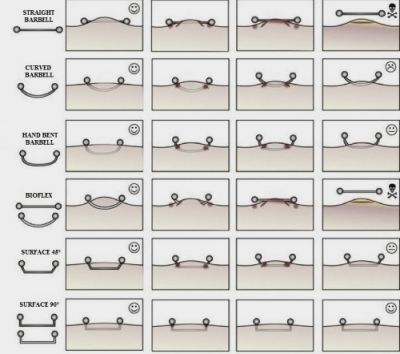
Surface piercing is located on the surface of the skin, typically on a flat part of the body. For this reason, the body is more prone to reject the jewelry. Sometimes migration or rejection can occur even after several years of wearing the piercing.
The only suitable jewelry for surface piercing is a surface bar with 90° angles, as shown in the picture.
Depending on the part of the body where the piercing is done, the surface jewelry may vary in length and thickness. When longer jewelry is used (e.g., for the sternum or nape), the body needs more time for the piercing channel to fully epithelize (to create a new layer of skin from the inside). An overly long piercing channel (over 25mm) can cause certain problems due to the accumulation of dead cells in the middle. The problem can be attempted to be resolved through regular drainage of the piercing, but considering the possible complications, two microdermals are a better and more sustainable option if you want the disks (the outer side of the jewelry) to be spaced more than 2cm apart.
Surface piercing was more commonly used before the appearance of microdermals. For some body positions (e.g., on the collarbone, hips, or lower back), we would not recommend it at all due to difficult healing and a high likelihood of rejection. Positions where it can hold well include the nape (back of the neck), sternum (middle of the chest between the breasts), surface tragus (sideburn), vertical bridge, lip surface.
For surface piercings (surface and microdermal), there are no guarantees of their long-term sustainability. Their ‘lifespan’ depends on their location, skin strength, jewelry, care, accidental mishaps, etc.
Cleaning according to the General cleaning procedure, Betadine (2.)
A microdermal is a type of surface piercing that doesn’t have an ‘exit’ (single point). When it is being placed and during the first few days, there may be some bleeding, which can be alleviated by applying cold compresses or ice. Depending on the placement, there might be slight swelling, bruising, and redness.
During the first week, you can use a small plaster over the piercing to prevent seepage of blood and to secure the jewelry. A microdermal is inserted through a single hole in the tissue, which needs to be slightly widened for the jewelry base to go under the skin. Until the tissue grows through the base of the jewelry, anchoring it, the jewelry can rotate within the channel or fall out if it gets caught. The plaster should not be too large, as it won’t sufficiently hold the jewelry against the skin. Due to the accumulation of blood, always remove the plaster by wetting it first. Prolonged use of the plaster can lead to skin irritation around the piercing.
Microdermals typically heal without major issues because they don’t have a long piercing channel like surface piercings. The average healing period is around 3 months, but the piercing may appear to be healed even before that. Redness and other side effects of a fresh piercing usually disappear within two weeks. Nevertheless, we do not recommend changing the jewelry until the full healing period has passed, to avoid injuring the tissue that has started to grow over the base of the jewelry when removing the attachment.

In this type of piercing, it is essential to regularly and carefully clean the skin around it. To avoid getting caught on the jewelry, you will mostly naturally circumvent it during showers or when drying with a towel after showering. Over time, this can result in the accumulation of dead skin cells in the area around the piercing. They can end up under the outer part of the jewelry and, through gradual buildup, widen the hole around the jewelry, which is a process that takes months but results in jewelry removal.
To prevent this, once or twice a month, give the broader skin area around the piercing a slightly more thorough cleanse – you can use a regular facial scrub. “Thorough cleansing” does not mean you have to scrub until it bleeds but only press a bit firmer to remove the surface layer of dead skin. After cleansing, apply moisturizing cream to the skin. It would be advisable not to do this during the first month while the microdermal is healing. You can test the need for scrubbing by gently scratching the skin with your nail during a shower – if you find bits of tissue under your nail, it’s time for scrubbing.
Microdermals can become infected like any other piercing. If you notice that the area around the piercing is extremely red, swollen, painful to touch, any discharge, or growths, be sure to visit the salon for a check-up.
Microdermal jewelry is made of high-quality titanium and should not pose a problem when passing through metal detectors or during various medical examinations (e.g., MRI). However, it will be visible on X-ray images. This is not a classic piercing that can be removed and reinserted as needed, so if you find yourself in a situation where it needs to be removed, please contact us.
Cleaning according to the General cleaning procedure, Septasol (1.)
In individuals with sensitive skin, the appearance of bruising is possible after piercing. During the first few weeks, increased sensitivity to touch and lymphatic discharge (thin mucus-like fluid) is normal.
It is recommended to avoid sleeping on the piercing as much as possible to prevent jewelry migration (healing at an angle) or issues with the growth of scar tissue. In the first month, avoid bathing in pools, lakes, or bathtubs (due to bacteria and chlorine). Bathing in the sea is not harmful; it actually helps with the healing process of any piercing because it acts as a natural saline solution (assuming the sea is clean).
For female nipple piercings, there might be a slightly longer healing period because it can be influenced by all changes in the body (PMS, hormones, immunity, etc.). Mild lymphatic discharge from the piercing canal is normal, but if it doesn’t stop after 3-4 weeks from piercing, focus on boosting your immune system (sleeping on the piercing can also lead to lymph leakage).
There are no specific rules regarding wearing bras; the key is to wear a clean, cotton one that doesn’t put pressure on the piercing. Be mindful of bras and clothing with holes into which jewelry balls could get caught to avoid any snagging.
Cleaning according to the General cleaning procedure, Septasol (1.)
For the first few days, slight bleeding from the piercing canal is possible, so we recommend wearing panty liners. VCH and HCH usually bleed less than labia piercings. During showering, you can use liquid intimate soap, but not more than once a day. For drying after a shower (in the first week or two), it’s preferable to use paper towels or toilet paper to reduce the risk of bacteria transmission. Avoid bathing in pools, lakes, and bathtubs for at least 3-4 weeks for VCH and HCH, and up to 2 months for other genital piercings. Bathing in the sea is not harmful; it actually aids in the healing process of any piercing as it acts as a natural saline solution (assuming the sea is clean). We recommend abstaining from oral sex for at least 2 weeks and using a condom for intercourse for 2-4 weeks (depending on the individual healing time of each piercing). Be careful not to snag the piercing.
Vertical Clit Hood (VCH) and Horizontal Clit Hood (HCH)
VCH is a piercing that can be done in 99% of women, whereas HCH requires unique anatomy. The piercing is done through the thin tissue that covers the clitoris, so there is no risk of loss of sensation. Piercing the clitoris itself can be very risky, and we do not perform it at Octopus. Both piercings are “problem-free.” Infections and inflammation are extremely rare, healing is fast and painless, and they don’t require excessive maintenance.
VCH is one of the “get it and forget it” piercings; it is so easy to maintain. It’s an excellent “starter” genital piercing.
HCH may potentially migrate (heal at an angle), depending on individual anatomy and jewelry choice.
Christina
In terms of healing and maintenance, Christina is a “hybrid” between navel and surface piercings. Due to the length of the piercing canal, it has a healing period of 6 months or more. The position is prone to jewelry rejection (the skin that holds the jewelry thins over time, and the body pushes the jewelry to the surface). The rate of rejection depends on anatomy, the person’s habits (sleeping on the stomach, wearing tight pants, etc.), proper positioning, and the choice of jewelry.
It is advisable not to wear very tight pants made of rigid materials and not to sleep on the stomach during the healing period to prevent the upper side of the jewelry from getting pulled into the piercing channel. If you notice this happening, be sure to come in for an examination. If you depilate the entire area, be very careful not to pull the jewelry (when using wax or paste) or introduce chemicals into the piercing canal (creams and shaving foam). During the healing period, it’s best to avoid depilating this area as usual and trim the hair around the piercing with nail scissors or use tweezers to pluck them.
The formation of scar tissue (fleshy bump resembling a subcutaneous pimple) is also common. The problem can be resolved relatively quickly if you come in for an examination and consultation in a timely manner; it’s crucial not to wait for it to resolve on its own because it typically won’t.
Labia
The inner labia are very similar to VCH piercings in terms of healing and maintenance. The piercing is done on thin tissue and mucosa, so it heals fairly quickly and without problems. At the beginning, there may be slight bleeding due to increased vascularity in that area.
Outer labia take longer to heal than inner labia because the tissue being pierced is thicker and not in contact with mucosa. As with Christina piercings, care must be taken when depilating to prevent jewelry from getting pulled or chemicals from entering the piercing canal. A piercing on the outer labia is usually more uncomfortable during daily activities (walking, biking, etc.), so it’s recommended not to wear very tight pants during the healing period.
Female genital piercings that we currently do not perform: Triangle, Fourchette, Deep Hood or Isabella, Nefertiti, Princess Albertina.
Cleaning according to the General cleaning procedure, Septasol (1.)
PA, RPA, and dydoe are located in highly vascular areas, i.e., on the glans, so more substantial bleeding is possible.
Prince Albert
One of the most common male genital piercings that may seem very painful at first but falls into the category of “problem-free” piercings with fast healing and minimal care. In the first few days, more substantial bleeding is possible, especially in the morning. Therefore, we recommend placing sterile gauze around the piercing and securing it with a bandage or tape when you’re not at home (if it’s not bleeding, it’s not necessary). Soaking in warm saline baths (you can buy saline solution at any pharmacy and simply pour it in a cup) helps alleviate pain, clean the piercing, and soothe skin irritation. It is not recommended to take baths until the piercing has completely stopped bleeding. Keep in mind that heat dilates the circulatory system, so applying cold compresses can help stop the bleeding. It’s advisable to avoid sexual intercourse for at least ten days, and after that, use protection for the next 2-3 weeks. Oral sex is not recommended for at least 2 weeks after piercing. Normal showering is fine; for the first few days, use a mild soap (PH 5.5) on the piercing area or rinse the area with warm water only. Conventional perfumed shower gels may contain various chemicals that can irritate the piercing. Avoid bathing in bathtubs and pools for at least 4 weeks. If the skin around the piercing canal is very dry, you can apply a drop of coconut or jojoba oil for hydration (1-2 times a week). Urinate after cleaning the piercing to remove any remaining disinfectant from the urinary canal.
Reverse PA
Reverse Prince Albert is somewhat more painful during piercing because the piercing exits on the upper side of the glans, where the tissue is thicker and more sensitive. However, it is very similar to the classic PA, so the same aftercare instructions apply. Healing takes an average of 2-3 weeks longer than for PA. A slight yellowish discharge (lymph) from the piercing canal and the formation of crusts are possible. Do not tear them off as it may damage the tissue. Before cleaning the piercing, soak the crusts in lukewarm water to soften them and then gently remove them.
Dydoe
Positioning is mainly possible in circumcised men or those with very stretchy foreskin; otherwise, various complications can arise during healing. Anatomy is also crucial for this piercing, as the man must have a very pronounced “coronal ridge.” It is one of the more painful male genital piercings, and if not positioned correctly, jewelry rejection is possible. Stronger bleeding is possible in the beginning, so it is advisable to use a dressing as with a PA piercing.
Frenum
Frenum is one of the simplest and least painful male genital piercings. By positioning multiple piercings, a Frenum Ladder can be created. The piercing is done on thin, stretchy skin, so the pain is minimal, and healing is relatively fast and not problematic. This piercing typically doesn’t bleed, swell, and doesn’t require much maintenance. Since the pierced skin is quite thin, jewelry migration (movement from the original piercing site) is possible.
Foreskin
Piercing the foreskin covering the glans is one of the simplest and least painful. It heals quickly, usually doesn’t bleed after piercing, doesn’t swell, and generally doesn’t cause problems during healing.
Scrotum
One of the most common positions for male genital piercing is on the scrotum. Piercing can be positioned on all parts, and almost any jewelry model can be used, from rings to barbells and bananabells (bent barbells). Healing takes a little longer because they are not surrounded by mucous membrane like, for example, PA, and the pierced skin is tougher. Although it seems that the piercing in this area is not in direct contact with the bodily secretions of others during sexual intercourse, to prevent possible complications during healing, it is advisable to avoid sexual intercourse for at least 1-2 weeks, and after that, use protection, and after intercourse, rinse the piercing area with clean water or saline solution. Scrotum piercing has countless variations when it comes to positioning, and the most popular ones are Lorum and Hafada.
Pubic
Pubic is a surface piercing located at the very base of the penis. The skin around the jewelry can become very dry and irritated if this area is shaved. It usually doesn’t bleed or cause significant problems during healing, but special care should be taken to avoid bumping and snagging on the jewelry because this can lead to jewelry rejection. If you shave the area around the piercing, it is necessary to ensure skin hydration and avoid contact with chemicals (shaving foams) with a fresh piercing.
Guiche
A piercing located on the perineum (perineal area). It is more common in men than in women. Due to its location, more attention should be paid to hygiene in the area around the piercing, not only during the healing period (6-9 months). Sitting sometimes poses a problem because it can lead to piercing irritation and potential jewelry rejection.
