


FOIL VS SUPRASORB
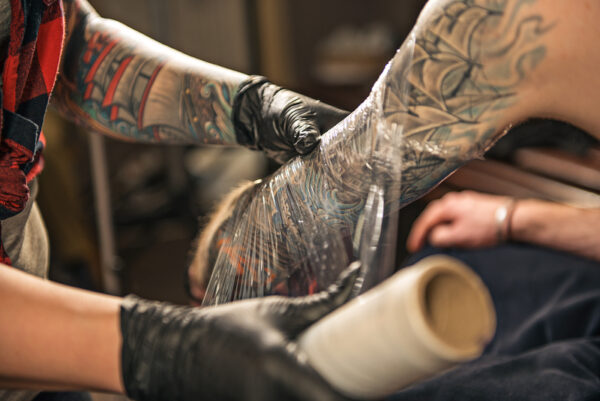
After getting a tattoo, it’s necessary to protect the skin with foil to prevent contact with environmental dirt. Foil serves to prevent the leakage of lymph and serous fluid from a new tattoo. If clothing or bedding sticks to the lymph or serous fluid, it can lead to the formation of scabs, which, when they fall off, can pull some ink from the tattoo. Under foil, the skin cannot breathe, which may result in inflammation, the development of pimples, and a deteriorated appearance of the tattoo.
The choice of foil depends on the tattoo design, size, body location, and the season. Consult with your tattoo artist to determine which type of foil is better for your tattoo.
Ordinary transparent foil (for household use)
Pros:
- Protects the tattoo from external influences.
- Can be removed as needed to allow cleaning of lymph, serous fluid, ink, and sweat from the tattoo.
- Readily available in any store.
- Inexpensive.
- No problems with removal (it does not stick to the skin).
Cons:
- Complete air impermeability to the wound (tattoo).
- Needs to be replaced every 2-3 hours (except during sleep).
- If you do not seal the edges, leakage of serous fluid and ink can occur.
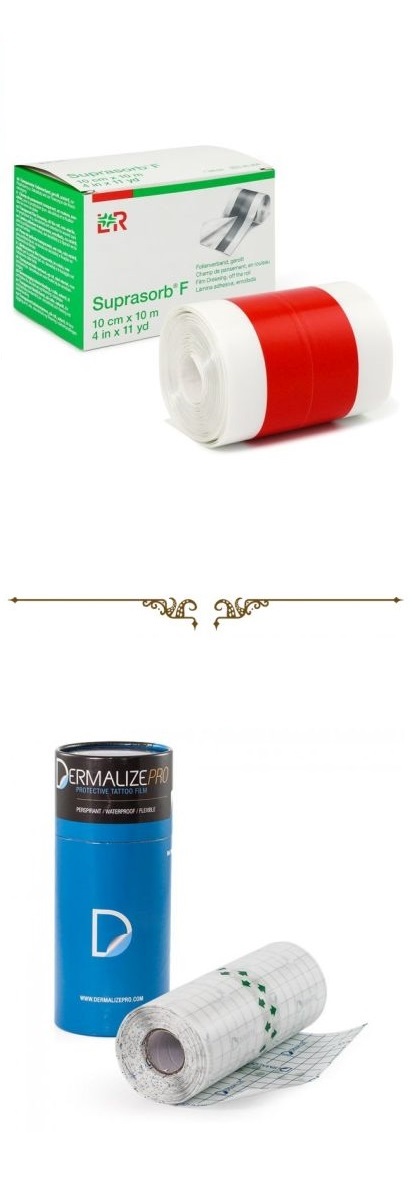
Suprasorb / Dermalize
Suprasorb/Dermalize (same product, different manufacturers) is a polyurethane transparent foil that is breathable and flexible. It creates a humid environment suitable for wound (tattoo) healing by exchanging gases and heat. Suprasorb protects the tattoo from external infection and does not interfere with showering, as excess moisture evaporates through the foil. During the wearing of Suprasorb foil, the tattoo does not need to be washed or moisturized, and the foil can be worn for 5-6 days without removal.
Although we all appreciate the advantages of this (non existant) tattoo maintenance, without the need to wash and moisturize every 2-3 hours, Suprasorb is not the ideal solution. For larger tattoos that have heavier discharge of lymph, serous fluid, and ink during the first few days, all these fluids accumulate beneath Suprasorb, and it cannot be washed or squeezed out without damaging Suprasorb, which loses its function in this case. Suprasorb adheres so strongly to the skin that we do not recommend removing it until at least 5-6 days after tattooing to avoid damage to the tattoo. It should be removed very slowly and gently under a stream of lukewarm water. After removal, the skin needs to be regularly moisturized with a nourishing cream. A tattoo under Suprasorb can become inflamed if it comes into contact with sweat, which is problematic since you cannot remove Suprasorb to clean the tattoo.
We do not recommend using Suprasorb during the summer months because increased sweating and heat can lead to tattoo inflammation, increased redness, a burning sensation, intense itching, and so on. Inflammation can result in lower quality or damage to the tattoo.
Pros:
- Protects the tattoo from external influences.
- Partial permeability allows the passage of air to the wound.
- Worn without removal for 5-6 days (the tattoo does not need to be washed or moisturized every 2-3 hours).
- Available in the form of various-sized patches or rolls.
Cons:
- Not available in all pharmacies.
- Costly.
- Very difficult to remove, which can result in tattoo damage.
- Lymph, serous fluid, and ink accumulate under it, creating a “watery bubble”.
- Frequent inflammation when worn during the summer months.
