


JEWELRY CARE
Like any other type of jewelry, piercing jewelry is subject to wear and tear from prolonged use. The main cause of this is that the jewelry is worn beneath the skin, in contact with lymph and blood in fresh piercings, and is not intended for frequent removal. Therefore, it is worn during activities like showering, swimming in the sea or a pool, exercising, dyeing hair, and in all other everyday situations. All of these factors can lead to certain piercing jewelry losing its color, and the gemstones on it may darken.
Take a moment to think of piercing jewelry as you would of a pair of shoes. There are many different models and manufacturers, and it’s up to you to choose the ones that suit you. First, you need to make sure you choose the right size because shoes that are too small will pinch, while shoes that are too big will slip off your feet. It’s the same with piercing jewelry – if it’s too small, it can compress tissue and lead to various problems; if it’s too large, it can snag everywhere and it doesn’t look good.
Next, you choose a shoe model you like and decide how much you’re willing to spend on them. There are beautiful, inexpensive shoes, but there’s a chance they will wear out quickly. Then there are some ordinary, maybe a bit more expensive shoes that are nothing special but are made of good material and durable, likely to last a long time. After that, there are brand-name shoes that come at a price, but you know you’re paying for quality and durability.
However, regardless of how much you paid and who produced them, shoes still show wear and tear from being worn. Even the most expensive pair, made of top-quality material, won’t look new after several years of wear. You have the option to repair them or buy new ones. We can apply all of this to piercing jewelry.

MATERIAL AND COLOR
Piercing jewelry is mostly made of implant-grade titanium and steel, which are originally silver in color and are colored through a process called anodizing or PVD coating (see the glossary).
Over time, the color on jewelry can wear off due to friction with the tissue. This is most noticeable with tongue piercings, where the top ball constantly rubs against the palate and loses its color over time. The color obtained through anodization wears off more quickly than PVD coatings.
At Octopus, we have an anodizer that allows us to achieve various shades of purple, green, blue, and yellow on titanium jewelry. Black, gold, and rose gold colors are achieved through the PVD coating added during the manufacturing process.
If you have older titanium jewelry whose color has worn off and you want to restore it, you can bring it to Octopus for cleaning, polishing, and anodizing. Re-anodizing jewelry may result in a different shade than the original.
Earrings and jewelry for stretched earlobes made of brass will oxidize over time. This is a natural process that will occur even if the jewelry is stored in a drawer. Yellow brass will lose its shine, and you may notice tiny spots on the surface.
If you have brass jewelry that could benefit from restoration, you can bring it for evaluation to see what can be improved through polishing.
Classic titanium and steel jewelry that is silver in color can also lose its shine and accumulate dead skin cells over time. To restore its original appearance, it needs to be cleaned in an ultrasonic bath and polished. Both of these services are available upon request at Octopus.
CUBIC ZIRCONIA
The longevity of cubic zirconia (CZ) is influenced by its quality and the way it is manufactured. Generally, more expensive CZ stones are of higher quality compared to cheaper ones. When it comes to piercing jewelry, there are two main methods of setting CZ stones: bezel set and prong set.
Bezel set means that the CZ stone is set within a metal casing that surrounds it. This type of mounting allows for the creation of very small and flat attachments for jewelry (e.g., for nose piercings) and is also used for larger attachments like those for belly button piercings.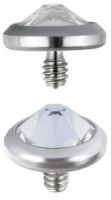
With extended wear and exposure to external factors (such as sweat, water or cosmetics) dust, dirt, and dead skin cells can accumulate between the metal casing and the CZ stone. If the CZ stone is originally transparent (referred to as “clear”), this can result in darkening. For CZ stones of darker colors, it’s not as noticeable since they mainly lose their shine without a change in color.
If you want a long-lasting bezel set model with a clear CZ stone, we recommend investing a bit more money and opting for branded jewelry. Most reputable piercing jewelry manufacturers (such as Anatometal, Industrial Strength, Shanga, and others) offer a lifetime warranty on their jewelry. This means that regardless of how much time has passed since your purchase, if the CZ stone falls out or darkens, you can bring the jewelry to the piercing studio where you purchased it, and they will send it back to the manufacturer. If the manufacturer determines that the jewelry was damaged due to a factory defect, they will send you an identical new model at no cost. The warranty does not cover damage caused by improper handling.
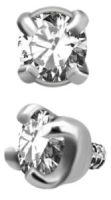 Prong set mounting for CZ stones means that the stone is held in place by several metal prongs. Due to its manufacturing method, the attachment is slightly more elevated than a bezel set, but there is a reduced chance of the CZ stone falling out of its setting. It also does not darken because there is an empty space between the CZ stone and the prongs holding it in place. Over time, dirt and dead skin cells may accumulate in this space, but it can be easily cleaned using an ultrasonic bath, restoring the CZ stone’s original shine.
We do not recommend wearing prong set attachments on tongue piercings and certain genital piercings to prevent injury to the tissue from the metal prongs. On all other piercings, they can be worn without issues.
This type of CZ setting allows for a longer lifespan, even with unbranded jewelry. If you choose jewelry from a reputable manufacturer, you’ll likely notice a difference in the CZ stone’s shine due to the finer finishing.
If you have a CZ stone that has lost its shine, you can bring it to the salon for an assessment of possible restoration. Clear bezel set CZ stones are often challenging to clean deeply enough to restore their original appearance, especially with cheaper externally threaded models. Cleaning in an ultrasonic bath, combined with polishing, achieves very satisfying results with prong set models.
The cost of cleaning, polishing, and anodizing starts at 4.00 eur or more, depending on what needs to be done on the jewelry, as well as its size and quantity.
