



CREATING A TATTOO DESIGN
If you don’t have a pre-existing design for your tattoo, our tattoo artists can create one for you free of charge. However, the design can only be taken out of the studio in the form of a tattoo on your skin. This policy is in place to prevent situations where a design created by our artists is taken to another studio for tattooing.
To make it easier for the tattoo artist to create the design, it’s helpful to gather several reference images. For instance, if you’re considering tattoo of an octopus, find images that showcase different aspects you like—such as the body position, the octopus itself, suitable background, and so on. The clearer you are in explaining your vision, the smoother and faster the design process will be, resulting in a tattoo you’ll be more satisfied with. If you are not 100% sure about what you want, please take the time to think it through before scheduling a consultation. It’s essential to have a clear idea because if your vision isn’t well-defined, it can be challenging to create a design that meets your expectations.
One important fact you must be aware of before getting a tattoo is that the skin is not paper; skin is a living organ that ages and changes. As a result, tattoos undergo changes over time. VDelicate lines and subtle shades can fade as skin cells regenerate, and ink that isn’t deeply embedded beneath the skin’s surface may diminish or disappear. Initially vibrant colors can also lose their intensity, and shades similar to skin tone may eventually fade entirely.
Every tattooed line will slightly expand and lose sharpness over the years. For this reason, certain basic rules of the profession must be followed during tattooing. One of these rules is the minimum feasibility. This means that not every design can be tattooed in the size it can be created on paper. If a design is initially tattooed too small, it will not be distinguishable after few years. Two lines must be at least 2-3mm apart to ensure that the tattoo looks good in the long term.
Every professional tattoo artist will advise you if the design you want is too small. This isn’t about trying to charge you more; it’s about ensuring your tattoo looks beautiful and maintains quality over time, representing the artist’s craftsmanship. While almost any design can be tattooed smaller than recommended, doing so may compromise its clarity and longevity. It’s important to understand that once a tattoo becomes a difficult-to-recognize blotch, fixing it can be challenging, often requiring a larger cover-up tattoo or laser removal.
TEXT DESIGN
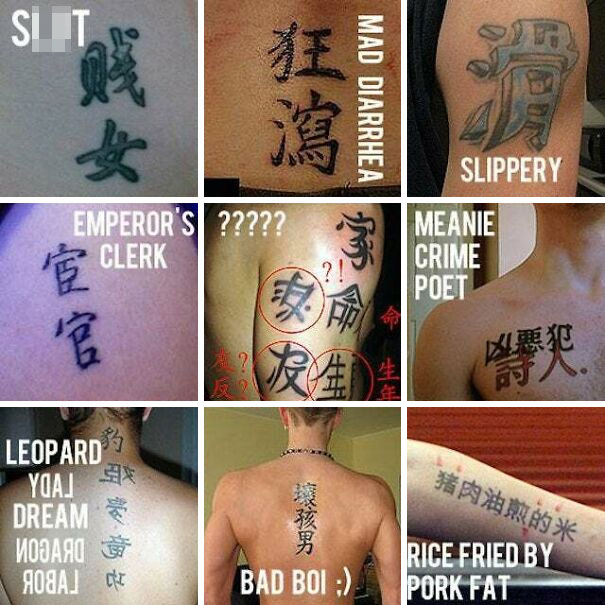
The responsibility for the accuracy of foreign language text tattoos lies entirely with the client, as tattoo artists may not be familiar with all languages and scripts worldwide. Clients are advised to ensure the correctness of their desired text before proceeding with the tattoo.
If you want to tattoo any type of text (name, quote, date, etc.), firstly we need to agree on the type of lettering (font) you want. There are countless fonts available, and you can find them on any online font generator, such as DaFont, 1001Fonts, etc. Keep in mind the minimum feasibility: highly ornate lettering = a larger tattoo.
We will use DaFont as an example:
for cursive or similar styles, choose the ‘Script‘ category, or subcategories ‘Calligraphy‘ and ‘Handwritten‘
for a simple font without many flourishes and decorations, check the ‘Basic‘ or ‘Script – school‘ categories
for initials (the first letter of a name and/or surname), you can look at categories like ‘Fancy‘ (subcategories ‘Curly‘, ‘Initials‘), ‘Gothic‘ (subcategories ‘Medieval‘, ‘Initials‘), ‘Script‘ (subcategories ‘Calligraphy‘, ‘Handwritten‘)
You can browse categories like ‘Foreign look‘ (‘Arabic‘, ‘Various‘), ‘Dingbats‘ (‘Runes,Elvish‘) – note that, for example, the ‘Arabic’ category does not contain real Arabic script or translate text from your language to Arabic; it is just a style of writing that resembles Arabic script.
DESIGN POSITIONING
A tattoo should be positioned in a way that complements the natural lines of the body, and there are certain industry rules regarding this. For example, if you tattoo a large square design in the center of your chest, it may not look the best. If you place a cross on your wrist, oriented so it stands upright when you look at it while your palm is facing your face, keep in mind that you will have an upside-down cross the whole time when your arm is down.
The tattoo artist can offer advice regarding positioning, size, and the overall design, but the final decision is up to you, and you bear full responsibility for the final check of the desired design. Please carefully review the design on paper and the stencil that is applied to your skin before the tattooing.
Subsequent complaints cannot be considered.

